
By Gavin Hewitson, Founder of In-box
Most ecommerce brands running Klaviyo have the same blind spot. Your abandoned cart, abandoned checkout, and browse abandonment flows can only email people Klaviyo can identify. If a shopper’s cookie has expired, they’re browsing on a different device, or they’ve never filled in a form, Klaviyo might not recognize them. They could browse your store several times, add something to their cart, and even start checkout without triggering a single abandonment email.
At In-box, we run email and SMS for more than 40 ecommerce brands at a time, mostly US Shopify stores on Klaviyo. One of the questions we get asked most is whether identity resolution tools are worth the investment, or just add noise to an account. So instead of giving you an opinion, this article walks through the real numbers from one of our clients, a US fine jewelry brand, after we layered Customers.ai underneath their Klaviyo abandonment flows.
What is identity resolution for Klaviyo? Identity resolution, also called website visitor identification, connects anonymous website visitors to known customer profiles. For Klaviyo, it means identifying shoppers Klaviyo doesn’t recognize and sending their on-site behavior into Klaviyo as events, so your abandonment flows can email them.
All figures below come straight from the brand’s Klaviyo account, pulled on November 16, 2026, using Klaviyo’s standard flow attribution with Placed Order as the conversion metric.
Key results: Klaviyo flow revenue from identity resolution
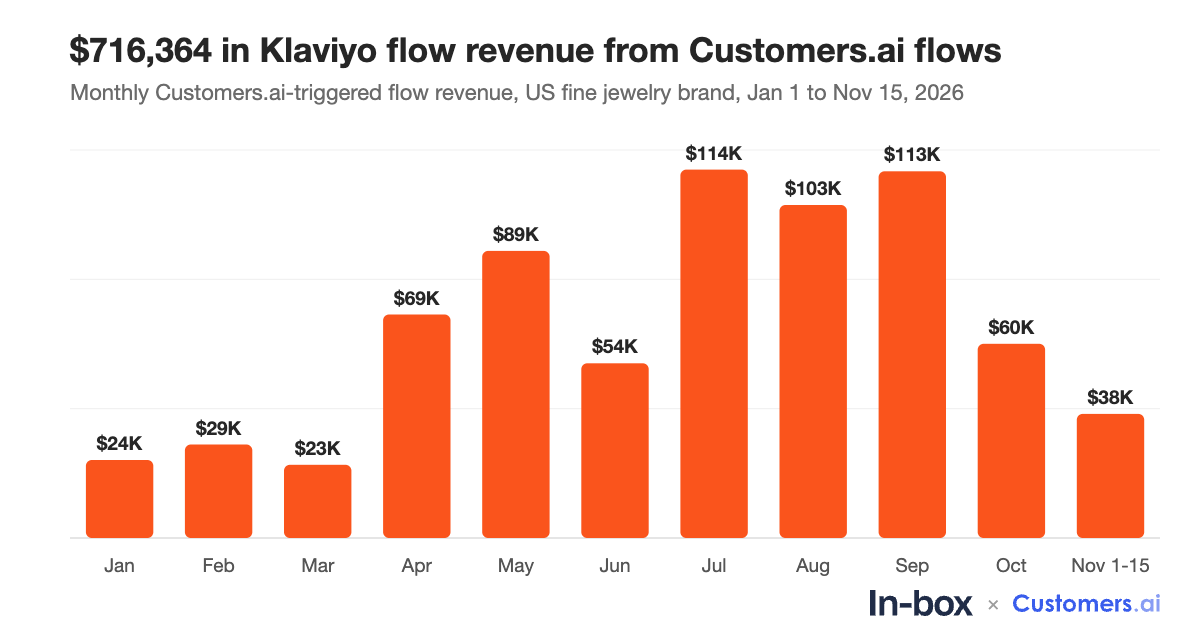
- $716,364 in revenue attributed to Customers.ai flows by Klaviyo from January 1 to November 15, 2026.
- That’s 17.4% of all flow revenue in the account over the same period ($4,114,413).
- Those flows sent 165,423 emails, earning $4.33 per recipient.
- Customers.ai flows contributed between 13.5% and 23.1% of flow revenue every single month.
- Customers.ai identified shoppers Klaviyo didn’t recognize and sent their on-site behavior to Klaviyo as events that triggered the abandonment flows.
- Every one of those flows was built to skip anyone already reached by the brand’s standard flows. These were shoppers the rest of the stack had missed.
The last point matters most, and it’s where it’s easy to go wrong. We’ll get to that in detail.
The brand: a fine jewelry store
The brand in our case study sells fine jewelry directly to consumers. These are classic high-consideration purchases, and average order values are high. People often spend days or weeks researching before they buy, visiting the same store more than once.
That buying pattern can make it harder to track customers. Someone might land on a product page from an Instagram ad on their phone, return to it on a work laptop two days later, and buy on a tablet during the weekend. Without a way to connect those visits, the store may see separate sessions rather than one shopper.
Browser privacy protections can make things more difficult. Apple’s Intelligent Tracking Prevention can delete JavaScript-created cookies and other browser storage after seven days of Safari use without interaction with a website. For someone taking weeks to make a purchase, that can mean losing the browser identifier that previously connected them to a known profile.
Paid traffic brings new shoppers to the site, many of whom Klaviyo may not recognize. Customers.ai can help identify some of those shoppers so they can receive abandonment emails.
If you sell jewelry, we cover the wider email strategy, from seasonal flows to discounting, in our guide to email marketing for jewelers.
The problem: abandonment flows only see part of your traffic
Klaviyo’s native abandonment triggers (Viewed Product, Added to Cart, and Checkout Started) rely on Klaviyo identifying the visitor. That happens when someone clicks a Klaviyo email, fills in a form, logs in, or still has a valid Klaviyo cookie from a previous visit.
That leaves several groups of shoppers your flows may miss:
- New visitors from paid ads who haven’t been identified yet.
- Existing subscribers whose cookies have expired or been cleared, particularly those browsing with Safari.
- Returning customers browsing on a different device from the one they bought on.
- People who previously interacted with the brand but are no longer recognized by Klaviyo.
In its 2024 Mobile Benchmark report, Quantum Metric found that 69% of consumers research high-value items on mobile but buy on desktop. For a jewelry brand with a long consideration window, that can mean missing a lot of high-intent sessions. Some of these shoppers may even reach checkout. Someone who’s started checkout is about as warm as a lead gets, but if Klaviyo can’t identify them, they may leave without receiving an abandonment email.
And with Baymard Institute putting the average cart abandonment rate at 70.22%, identifying shoppers who reach checkout becomes even more valuable.
Customers.ai helps fix that by identifying visitors Klaviyo doesn’t recognize and sending their on-site behavior into Klaviyo as its own set of events: Customers.ai Product view, Customers.ai Added to Cart, Customers.ai Checkout Started, and so on. Those events can then trigger flows exactly like Klaviyo’s native ones.
To give a sense of scale, in a single week in November 2026 the brand’s account logged 1,246 Customers.ai Checkout Started events, roughly 150 to 220 a day.
How identity resolution powers more abandonment flows
Customers.ai is the identity resolution and visitor identification layer in the three-layer setup described below. In this account, it does five things:
- Identifies visitors Klaviyo doesn’t recognize. Visitor identification covers new paid-traffic visitors, subscribers whose cookies have expired, and returning customers on a different device.
- Sends their on-site behavior to Klaviyo as events. Customers.ai Product view, Customers.ai Added to Cart, and Customers.ai Checkout Started show up in Klaviyo’s Metrics as their own events.
- Triggers flows exactly like Klaviyo’s native events. We built abandoned checkout, abandoned cart, and browse abandonment flows on those events, plus seasonal versions for peak periods.
- Installs through Shopify’s Customer events. On Shopify, you add it as a custom pixel under Settings > Customer events.
- Adds revenue on top of your existing flows. From January 1 to November 15, 2026, Klaviyo attributed $716,364 to the Customers.ai flows, 17.4% of the account’s flow revenue.
For a closer look at the product, see Customers.ai’s Klaviyo integration and its identity resolution overview.
How we set it up: the waterfall
Here’s a mistake we see a lot with the brands we work with. They install an identity resolution tool, clone their abandoned cart flow, swap the trigger, and switch it on. The problem is that a shopper Klaviyo already recognizes can end up receiving both the native abandonment email and the Customers.ai version.
Now you’ve got customers receiving duplicate emails, more unsubscribes, and revenue showing up in the Customers.ai flows that might otherwise have been credited to your existing flows.
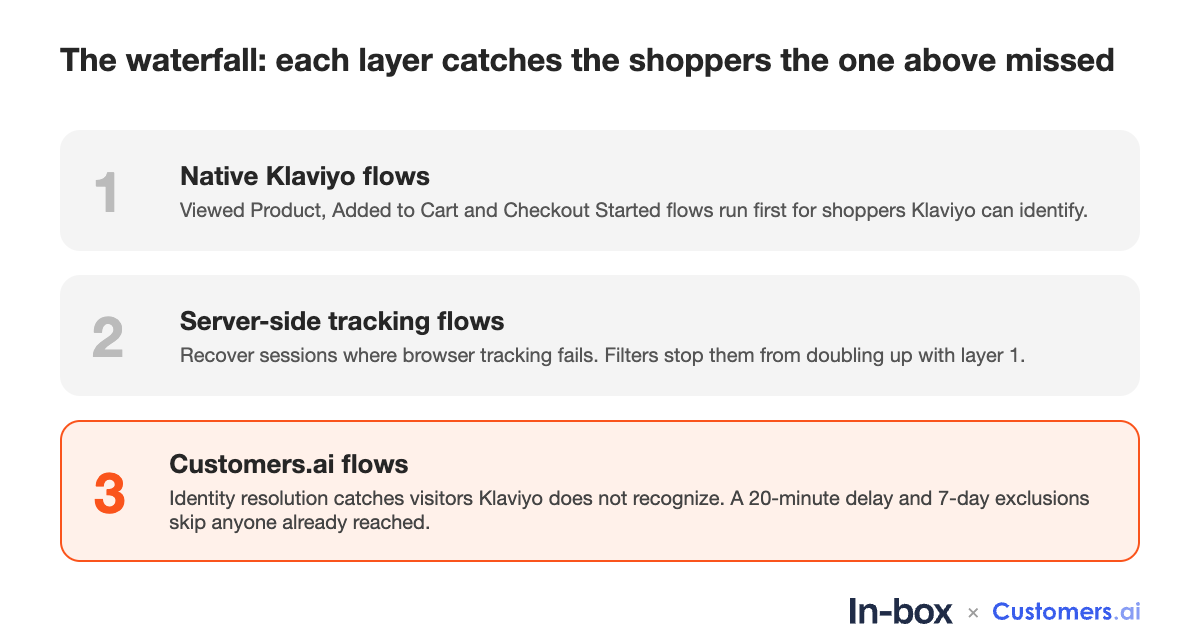
We took a different approach with this brand and built the flows as a waterfall. Each layer catches the shoppers the one above it missed.
Layer 1: native Klaviyo flows
The standard Viewed Product, Added to Cart, and Checkout Started flows run first. If Klaviyo can identify the shopper, these flows handle them.
Layer 2: server-side tracking
The account also runs a server-side tracking layer that recovers some sessions where browser tracking fails. It feeds its own events and its own set of parallel flows, with filters designed to stop them doubling up with Layer 1.
Layer 3: Customers.ai
The Customers.ai flows sit underneath both and trigger on Customers.ai events. Their profile filters exclude anyone who has already been reached.
Here’s how the live Abandon Checkout (Customers.ai) flow is filtered in Klaviyo:
- Trigger: Customers.ai Checkout Started
- Profile filter: Placed Order zero times since starting this flow
- Profile filter: Received Email zero times in the last 7 days where Flow equals the native Abandon Checkout flow
- Profile filter: Received Email zero times in the last 7 days where Flow equals the server-side Abandon Checkout flow
- Profile filter: Can receive email marketing
- First step: a 20-minute time delay, so the native flow gets the first chance to fire
The browse abandonment flow has stricter filters because browsing is a weaker buying signal. Anyone who’s added to cart or started checkout through any of the tracking sources since entering the flow is excluded, as is anyone who’s received a browse abandonment email in the last seven days. That way, shoppers don’t get a Customers.ai browse email if another flow has already reached them.
The result is a clean hierarchy. The existing flows get the first chance to reach a shopper, and Customers.ai catches whoever falls through the gaps. With this setup, Klaviyo attributed $716,364 in revenue to the Customers.ai flows without the brand simply sending more abandonment emails to shoppers its existing flows had already reached.
If you’re looking to build a similar waterfall setup, our complete guide to Klaviyo flows covers the core abandonment flows, including how to time them and use filters to prevent shoppers from receiving overlapping emails.
The results
Month by month
Here’s how much revenue Klaviyo attributed to the Customers.ai flows each month, alongside the account’s total flow revenue:
| Month (2026) | Customers.ai flow revenue | Total flow revenue | Customers.ai share |
|---|---|---|---|
| January | $24,109 | $117,367 | 20.5% |
| February | $28,912 | $165,265 | 17.5% |
| March | $22,635 | $127,660 | 17.7% |
| April | $69,124 | $298,794 | 23.1% |
| May | $88,779 | $480,651 | 18.5% |
| June | $54,033 | $400,900 | 13.5% |
| July | $113,924 | $563,116 | 20.2% |
| August | $103,001 | $574,235 | 17.9% |
| September | $113,405 | $779,319 | 14.6% |
| October | $60,052 | $385,705 | 15.6% |
| November 1–15 | $38,390 | $221,401 | 17.3% |
| Total | $716,364 | $4,114,413 | 17.4% |
Two things stand out.
First, Customers.ai maintained a consistent share of flow revenue. Its monthly contribution ranged from 13.5% to 23.1%, even as the account’s total flow revenue fluctuated. It wasn’t just a strong month here and there.
Second, Customers.ai accounted for its highest share of flow revenue in April, at 23.1%, ahead of Mother’s Day. It’s a useful reminder of why identifying shoppers matters during major gifting periods, when people may be visiting a store for the first time or browsing across multiple devices.
By flow type
Here’s how the Customers.ai flows performed from February 15 to November 15, 2026, broken down by flow type. The figures also include seasonal versions of these flows.
| Customers.ai flow type | Revenue | Emails delivered | Revenue per recipient |
|---|---|---|---|
| Abandoned checkout | $261,600 | 15,398 | $16.99 |
| Abandoned cart | $70,756 | 14,289 | $4.95 |
| Browse abandonment | $328,356 | 128,825 | $2.55 |
A few lessons from this breakdown:
Abandoned checkout delivered the highest revenue per recipient. At $16.99 per recipient, the Customers.ai checkout flow performed particularly well. That’s higher than the brand’s native abandoned cart flows, which earn $15.52 per recipient. These shoppers got as far as checkout, making them valuable people to reach when the existing abandonment flows haven’t already contacted them.
Browse abandonment brought in the most revenue overall. Per-email returns are lower, but browse abandonment reaches far more recipients than checkout abandonment, and $328,356 at $2.55 per recipient is a big number. For a high-AOV brand, even a relatively small number of purchases can add up to substantial revenue.
Customers.ai doesn’t need to match your native flows to be valuable. The brand’s native abandoned checkout flows earned $37.68 per recipient, more than double the Customers.ai version. That difference makes sense. Native flows reach shoppers Klaviyo already recognizes, and many of them may already have a relationship with the brand. Customers.ai reaches shoppers the existing tracking has missed, including new visitors who may be less likely to buy.
The goal isn’t to get the same revenue per recipient from both flows. It’s to capture revenue from shoppers your existing flows wouldn’t otherwise reach. For this brand, that meant $716,364 in Klaviyo-attributed revenue from the Customers.ai layer.
A second data point: an online art brand
One account doesn’t make a pattern, so let’s look at another. We also set up Customers.ai for an online art brand. It’s a smaller store with a much lower average order value, and we ran the same three-layer waterfall.
| Month (2026) | Customers.ai flow revenue | Total flow revenue | Customers.ai share |
|---|---|---|---|
| March | $2,672 | $19,991 | 13.4% |
| April | $3,489 | $28,273 | 12.3% |
| May | $6,048 | $62,856 | 9.6% |
| June | $7,259 | $68,370 | 10.6% |
| July | $7,112 | $76,949 | 9.2% |
Over those five months, Klaviyo attributed $26,580 to the Customers.ai flows, roughly 10% of the account’s total flow revenue. That’s a lower share than the jewelry brand, which makes sense given the difference in order values and buying behavior. Even so, about a tenth of flow revenue from one extra layer is meaningful for a store this size.
This account also taught us two lessons the hard way.
Lesson 1: don’t mail your identified-visitor list like a subscriber list. Early on, the account ran a welcome-style flow to everyone Customers.ai identified. It sent 10,877 emails and earned just $245. The generic welcome flow barely converted, while the behavior-triggered flows did much better. They followed up on what shoppers had actually done on the site, rather than treating every identified visitor like a new subscriber.
Lesson 2: keep an eye on your event tracking. In August, Customers.ai events stopped coming into this account, which meant the flows weren’t being triggered. Klaviyo flagged the drop in event volume, but it’s something you could easily miss if you’re only checking revenue. Set up an alert for sudden drops in Customers.ai events so you know when something’s gone wrong.
The playbook: how to set up identity resolution in your Klaviyo account
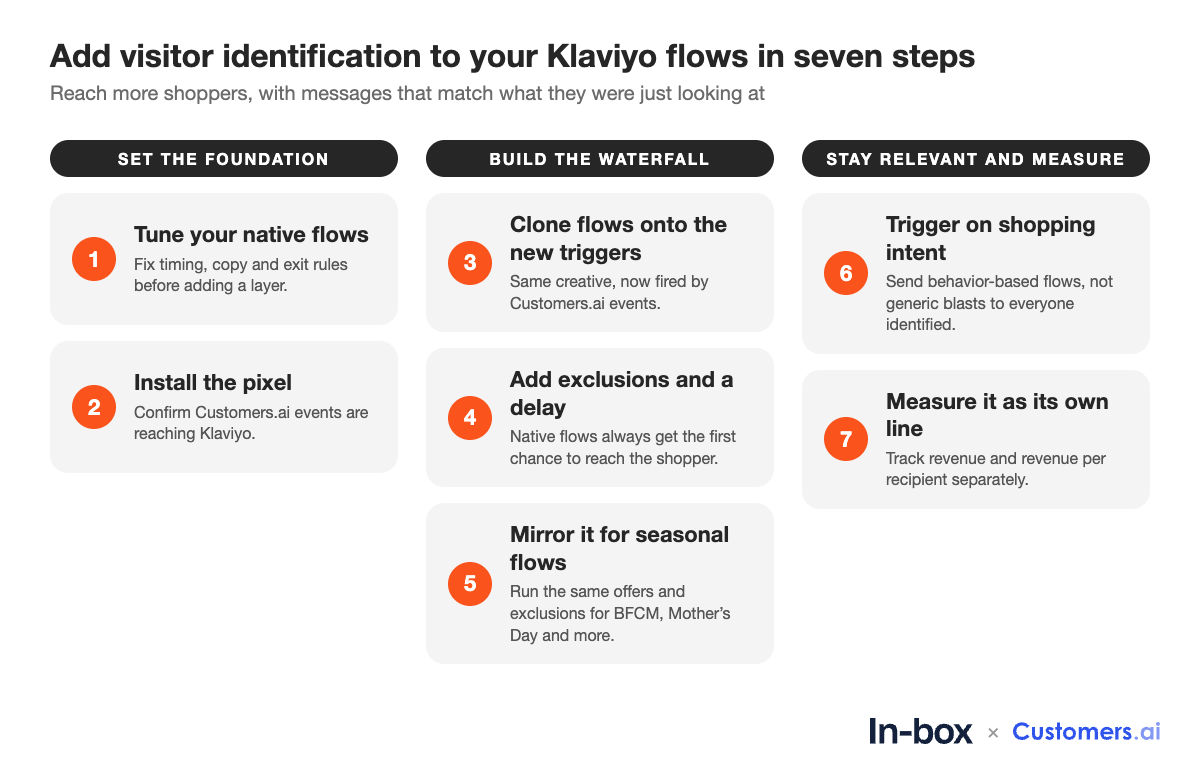
If you want to replicate this, here’s the order we’d do it in.
1. Get your native flows right first
Identity resolution makes good flows reach more people, but it won’t fix weak ones. Make sure your native browse, cart, and checkout flows have sensible timing, effective email copy, and clean exit conditions before you add another layer.
2. Install the pixel and confirm the events arrive
On Shopify, you can install Customers.ai as a custom pixel through Settings > Customer events. Once it’s connected, check Klaviyo’s Metrics page for the Customers.ai events (Product view, Added to Cart, Checkout Started, and so on) and make sure the events are coming through as expected.
3. Clone your native flows onto the new triggers
Copy your native abandonment flows and switch each trigger to the matching Customers.ai event. Keep the creative close to the original so the brand experience is the same no matter which layer a shopper lands in.
4. Add the exclusion filters
This is the most important step. For each Customers.ai flow, exclude anyone who has received the equivalent native flow (and any other tracking layer’s flow) in the last seven days. For browse flows, also exclude anyone who has added to cart or started checkout through any source.
Add a short time delay at the start of each Customers.ai flow, and check that the timing and filters give your native flows the first chance to reach the shopper.
5. Mirror the setup for seasonal flows
If you run seasonal versions of your abandonment flows for Black Friday, Mother’s Day, and so on, create a Customers.ai version of each and give it the same exclusions. In Bluecore’s Black Friday 2025 benchmark study, retailers could identify just 27% of their website visitors. That’s a lot of shoppers your existing flows might miss, so make sure your Customers.ai flows are running the same seasonal offers.
6. Don’t broadcast to identified visitors
Use Customers.ai events to trigger flows based on behavior. Don’t build a generic newsletter or welcome series for everyone it identifies. Make sure you’re only emailing people you are permitted to contact.
7. Report it as its own line and monitor it
Tag or name the Customers.ai flows clearly so you can report their share of flow revenue each month, and set an alert for sudden drops in event volume. If the events stop coming through, check the tracking before you start changing your emails.
A note on how we measured this
All revenue figures here are Klaviyo-attributed flow revenue using Klaviyo’s standard attribution window, with Placed Order as the conversion metric. That means a conversion is credited to an email if the shopper opened or clicked it within the attribution window and then bought.
Like any attribution model, it isn’t a perfect measure of how many sales happened only because of the emails. Some of these shoppers might have come back and bought anyway. But we have good reasons to trust the $716,364 figure as revenue attributed to shoppers the existing flows weren’t reaching:
- The exclusion filters kept shoppers who’d already received a native or server-side abandonment email out of the Customers.ai flows. That meant we weren’t sending them another abandonment email through Customers.ai.
- The Customers.ai flows consistently accounted for a meaningful share of total flow revenue over ten and a half months, even as the account’s overall revenue fluctuated.
If you want to know how much revenue the flows actually add, you can run a holdout test. Keep 10% of eligible shoppers out of the Customers.ai flows and compare their purchase behavior with the other 90%. Give the test enough time to collect meaningful results.
Is identity resolution worth it for your store?
Based on these two accounts, here’s how we think about it:
- High order value and long consideration (jewelry, furniture, premium goods): identity resolution is particularly valuable for these brands. Shoppers often take their time and return across devices, so recovering even a handful of missed checkouts can mean substantial revenue. The jewelry brand here got 17.4% of its flow revenue from the Customers.ai layer.
- Growing paid traffic: a strong reason to invest in identity resolution. You’re paying to bring new shoppers to your site, but Klaviyo won’t necessarily recognize them all. Identifying more of those visitors gives your abandonment flows a chance to bring in revenue they’d otherwise miss.
- Lower order value, smaller stores: still worth testing. Roughly 10% of flow revenue at the art brand is a real number, but check it against your plan cost.
The setup matters just as much as the tool itself. A waterfall with proper exclusions helps you reach shoppers your existing flows have missed and capture more revenue without sending them the same abandonment emails twice. Skip those exclusions, and you risk double-emailing customers and making the results harder to interpret.
Additionally, the identity tool you use matters. We have experience with other identity resolution tools and have found Customers.ai is the most accurate, drives the best performance, and its validation and quality control features ensure a brand maintains excellent deliverability.
Frequently asked questions about Klaviyo visitor identification
What is identity resolution (visitor identification) for Klaviyo?
Identity resolution, also known as visitor identification, connects anonymous website visitors to known customer profiles. For Klaviyo, it means identifying shoppers Klaviyo doesn’t recognize and sending their on-site behavior into Klaviyo as events, so your abandonment flows can email them.
How much revenue can visitor identification add to Klaviyo abandonment flows?
For the US fine jewelry brand in this case study, Klaviyo attributed $716,364 to Customers.ai flows from January 1 to November 15, 2026. That was 17.4% of the account’s $4,114,413 in flow revenue. For a smaller online art brand with lower order values, the share was roughly 10% over five months, or $26,580. Results depend on order value, traffic mix, and how long shoppers take to buy.
Does Customers.ai cause duplicate abandonment emails?
Not when you build the flows as a waterfall. In this setup, each Customers.ai flow excludes anyone who received the matching native or server-side flow in the last seven days, and starts with a 20-minute delay so the native flow gets the first chance to fire.
How do you set up Customers.ai visitor identification with Klaviyo on Shopify?
Install the Customers.ai visitor identification pixel as a Shopify custom pixel through Settings > Customer events, then confirm the Customers.ai events appear in Klaviyo’s Metrics page. Clone your native abandonment flows onto the Customers.ai triggers, add the seven-day exclusion filters and a short time delay, and report the flows as their own line.
Which Customers.ai abandonment flow earned the most?
Browse abandonment brought in the most revenue overall ($328,356), and abandoned checkout earned the most per recipient ($16.99). Abandoned cart brought in $70,756 at $4.95 per recipient. Figures cover February 15 to November 15, 2026.
Is identity resolution worth it for a lower order value store?
It’s still worth testing. The online art brand in this article, with a much lower average order value, earned roughly 10% of its flow revenue from the Customers.ai layer. Check that against your plan cost, and run a holdout test to see how much revenue the flows add.
About Customers.ai
Customers.ai is a Klaviyo partner that provides website visitor identification, matching anonymous shoppers and sending their on-site behavior into Klaviyo, so brands can email more of the shoppers they’re already paying to attract. See how it works for email marketers.
About the author
Gavin Hewitson is the founder of In-box, an email and SMS marketing agency for ecommerce brands. In-box is a Klaviyo Gold partner and has worked with more than 500 ecommerce brands on their retention marketing.