
Conversion API / Server-side / identity-resolved
Meta CAPI, with identity attached
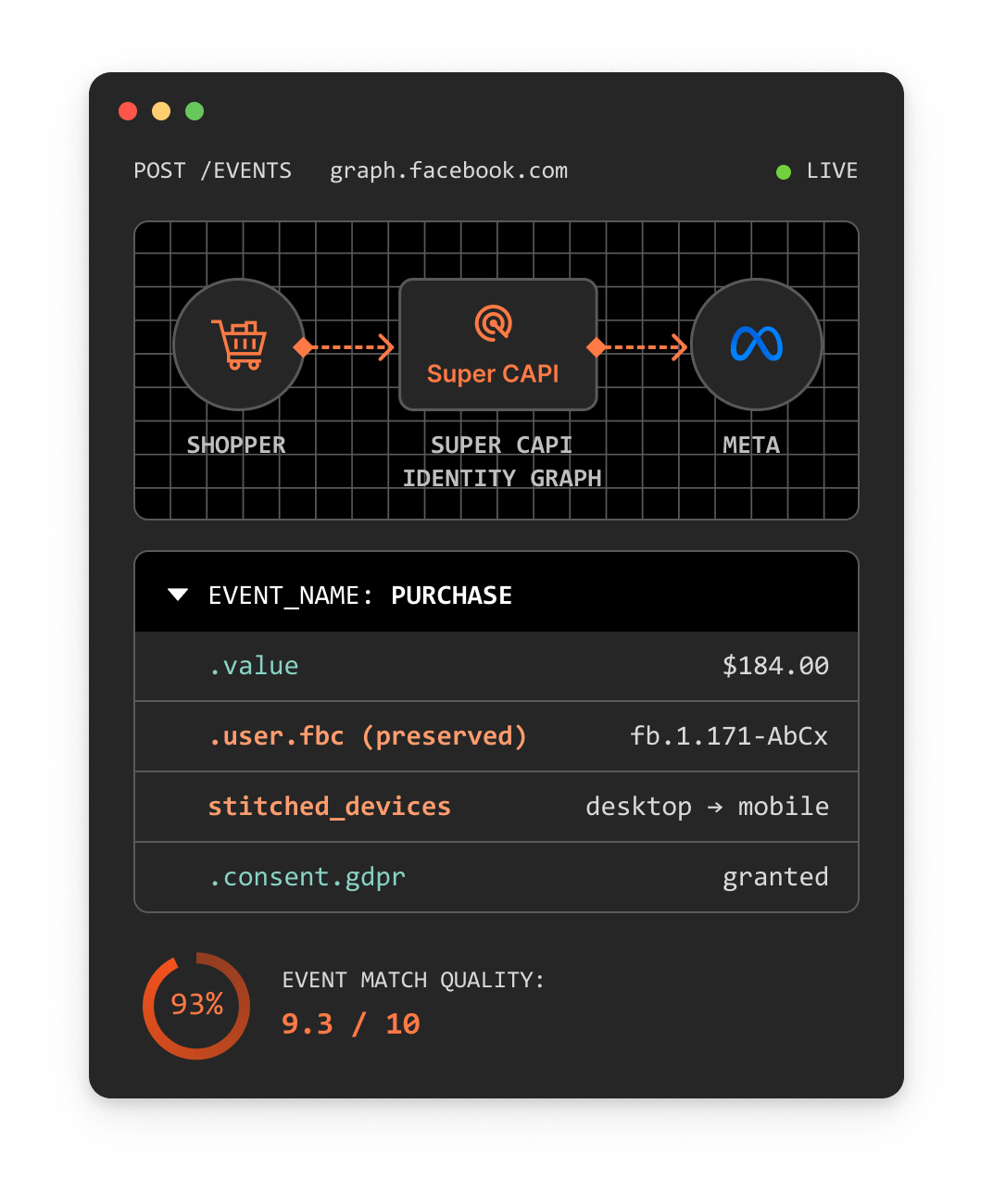
One click to switch on. Server-side events enriched with the strongest identity in the space — higher EMQ, better optimization, more spend going to people who actually buy.
- no gtm rebuild
- no setup fees
- no dev tickets
- 10-minute switchover




Meta can't optimize for buyers it can't see
Native pixels miss most of what matters. Native Shopify CAPI and most apps fill some of the gap — but they don’t have an identity layer. Low EMQ, weak signal, wasted spend.
40–60%
of conversions your pixel never sees — iOS, ad blockers, consent banners, cross-domain checkouts.
1 day
is how long Safari keeps client-side cookies. The click ID that drove the buyer? Gone before they convert.
2x
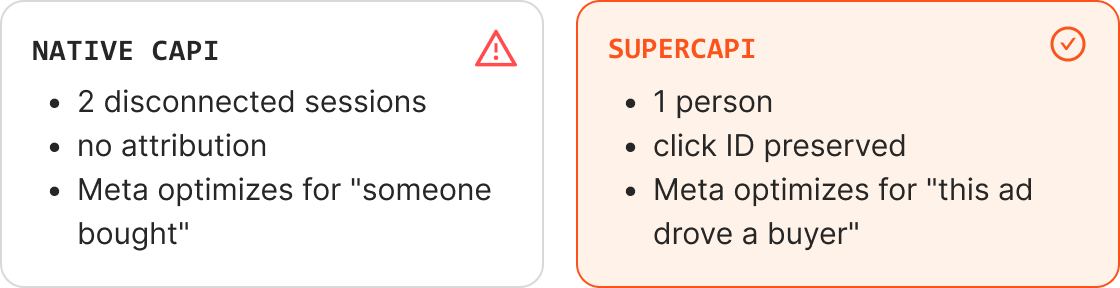
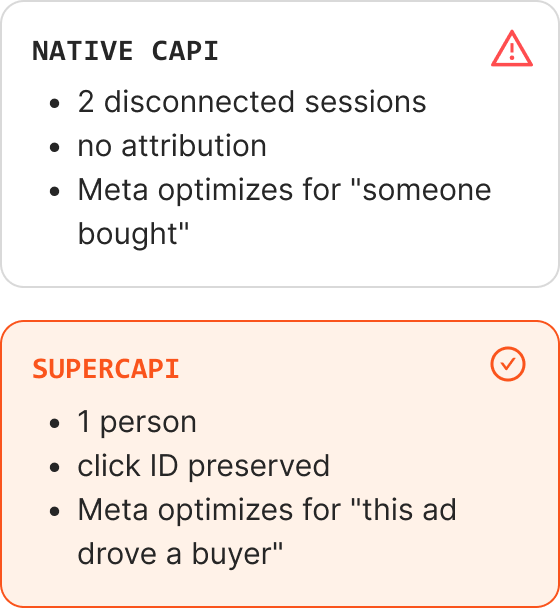
the same buyer counted twice: once on desktop, once on phone. Two disconnected sessions, zero attribution.

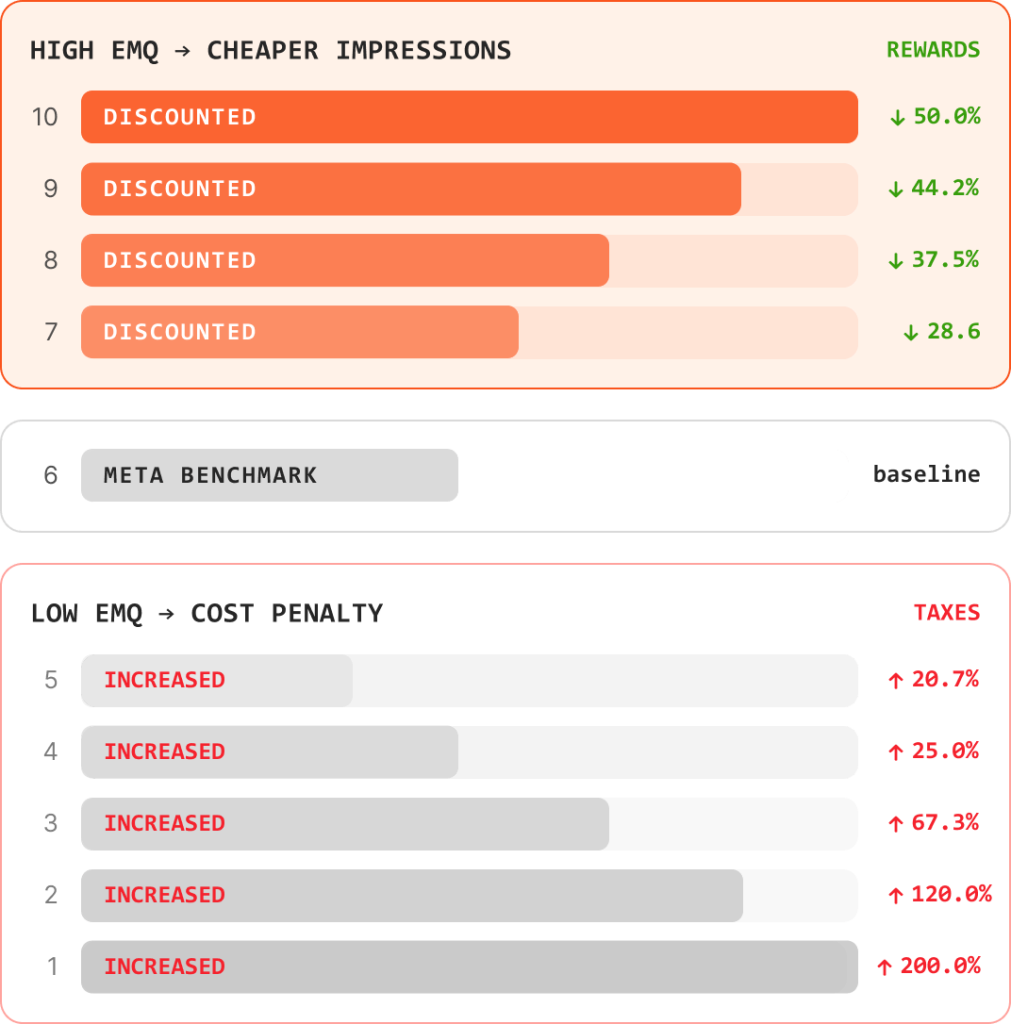
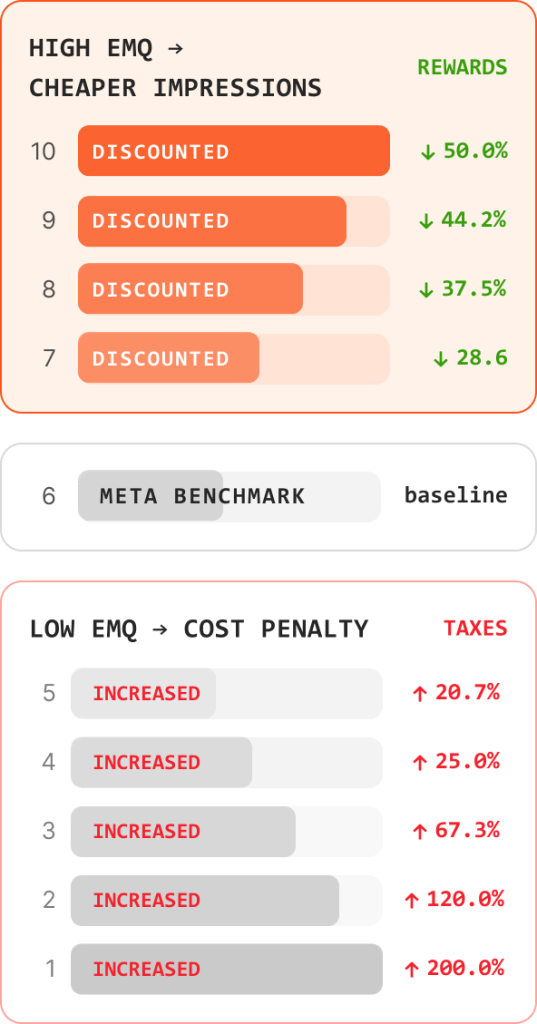
Meta charges you up to 200% more for low-quality events.
Event Match Quality isn’t a vanity score — it’s a multiplier on every dollar you spend. Accounts above benchmark get discounted impressions; accounts below benchmark get taxed. Most brands sit on the wrong side of the line and never know.
With Super CAPI
Brands that switch from native CAPI to Super CAPI typically clear the benchmark in the first week — and start banking the discount in the second.
Industry avg / no enrichment
Event Match Quality → Ad Cost Multiplier

Four things every other CAPI tool doesn't do
Most tools just forward events. We forward events and we have the strongest identity capabilities in the space — wired into the rest of the CustomersAI stack.
CustomersAI can resolve identity for purchases made through Amazon, TikTok Shop, eBay, Walmart, Target, and other marketplaces. Those conversions can be sent through CAPI for attribution, targeting, suppression, and optimization.
A visitor on mobile yesterday and desktop today is one person to us — and one person to Meta. Meta learns who buys, not which browser converted.
Links clicked inside Instagram, Facebook, ChatGPT, and other apps often open in isolated web views. CustomersAI can connect those visits to later sessions, preserving identity and attribution.
Traditional CAPI can send page views, product views, cart events, and checkout events after a purchase or signup. CustomersAI can send pre-conversion events like product view and add to cart tied to accurate identities.

Don't outsource your tracking to Shopify
Shopify’s recent web-pixel update broke Meta CAPI for half the storefronts on the platform. Built-in tools nobody is really maintaining will keep leaving advertisers out to lunch. Own the path your data takes.
Shopify rolled an update to web pixels that silently broke Meta CAPI delivery for thousands of storefronts. No alert, no rollback, no postmortem. Brands watched ROAS dashboards collapse for weeks before figuring out the problem wasn’t their ads — it was their data pipe
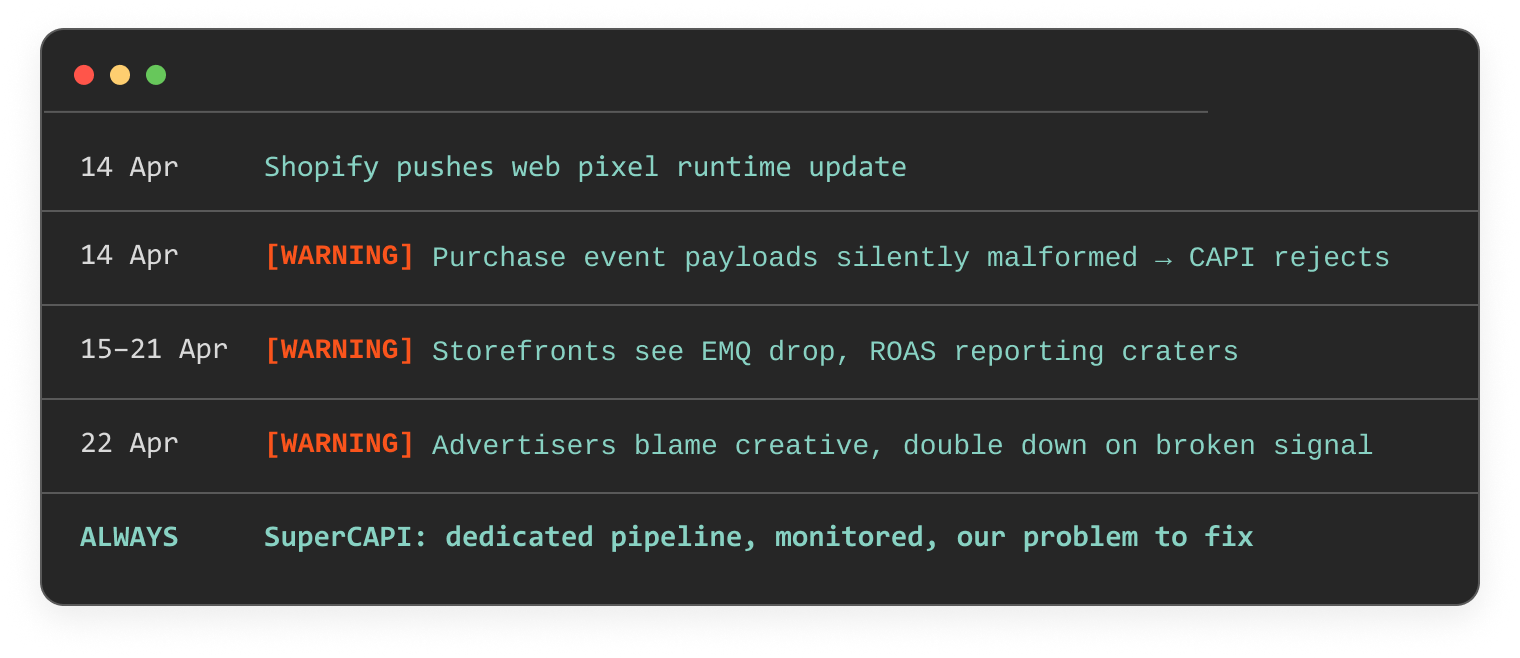
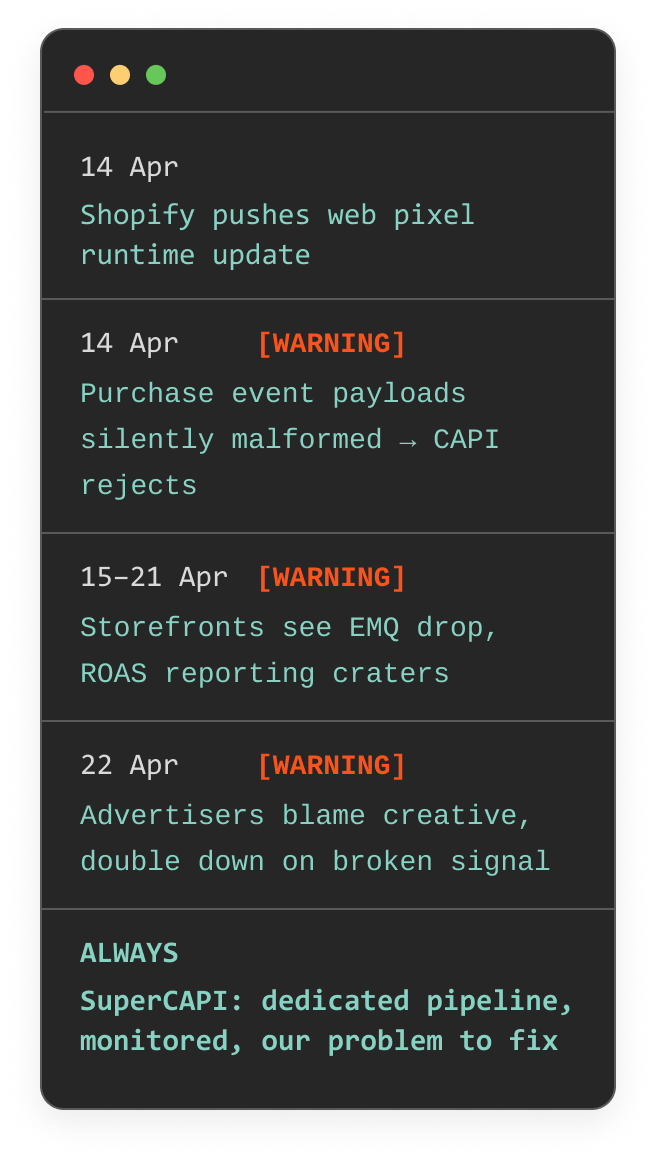
That’s the trade. If your CAPI is a side feature of a platform that owns 10,000 other features, it’s nobody’s job. A dedicated tool is somebody’s job — ours.
Value Optimization, Predicted LTV bidding, and the new value-based lookalikes all run on one assumption: that the buyer Meta saw last month is the same buyer it sees today. Break the identity and the model breaks with it.
When the same person shows up on a new browser, a new device, or a new session and you send Meta a fresh anonymous event, Meta’s pLTV model treats them as a brand-new low-value customer. Your real $400 buyer looks like a $40 one. Your bidding follows the wrong number.
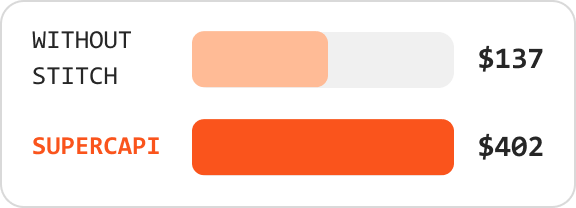
The more you enrich, the better Meta optimizes It's time to take control.


Cookies were built for one browser. Buyers aren't.
Safari kills them in 1 day. Ad blockers wipe them on contact. Switch devices and they’re gone. Our identity graph doesn’t have those limits.
Facebook click IDs & cookies, kept indefinitely.
When someone clicks your ad, Meta drops click IDs (fbc, fbp) that are critical for attribution. Standard browser storage holds them for days or weeks. We hold them indefinitely, tied to the person — not the browser.








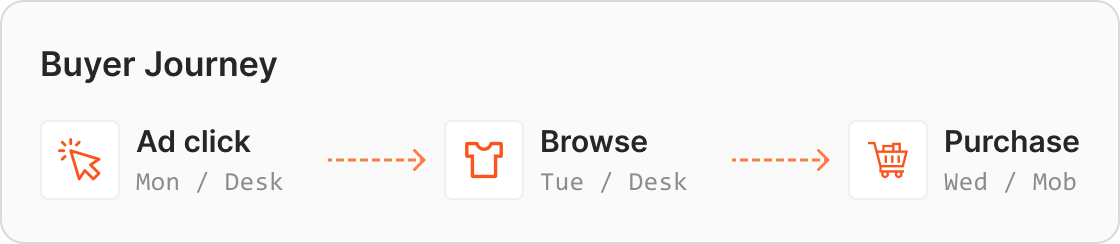
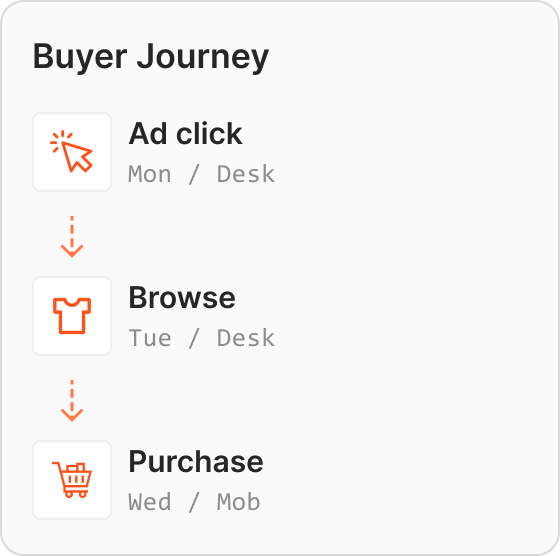
Click on desktop, buy on phone — credited to the ad that drove it.
This is where standard CAPI quietly loses you money. Every other tool sees two disconnected sessions and no attribution. We stitch them into one person and carry the original click forward.
Every Meta event, server-side, enriched.
Full standard Meta event coverage with deduplication, consent awareness, and identity attached to every payload.
- PageView
- ViewContent
- InitiateCheckout
- AddPaymentInfo
- Purchase
- Lead
- CompleteRegistration
- Search
- Subscribe
- + Facebook click IDs
- + Facebook cookies
- + Hashed PII
Plus, on every event:
Persisted fbc & fbp beyond cookie lifespan
Deduplication against any remaining browser pixel events
Full GDPR / CPRA consent awareness, passed through
Stitched external_id across devices & sessions
Hashed identifiers (em, ph, fn, ln) from the identity graph
One feedback loop. Closed.
Super CAPI doesn’t stand alone. It plugs into the rest of CustomersAI — so the same identity that powers your CAPI events also drives your audiences and your email.
Alfred
AI Audience Agent for Klaviyo serves up segments that cut costs and increase orders automatically.
Inboxer
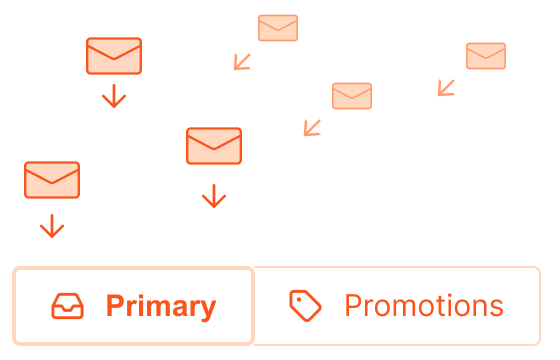
Revenue increases as emails go from the Promotions tab to the Primary inbox where customers will see them.

All Deliverability Tools
Full suite of tools to get your message in front of your audience — from validation to warming and more.
Most CAPI tools forward events. We do more.
Identity-resolved enrichment, click IDs preserved beyond cookie lifespan, cross-device stitching, and a closed loop with Klaviyo & Meta. Nobody else ships all of it.
Label
Super CAPI
Elevar
Triple Whale
Shopify Native
Super CAPI
Yes
Yes
Yes
Yes
Yes
Yes
Yes
Soon
Soon
Elevar
GTM rebuild
No
No
No
No
Limited
No
None
No
Triple Whale
Pixel install
No
Afterthought
No
No
No
No
None
No
Shopify Native
Yes
Yes
No
No
No
No
No
No
No
Comparison based on public product docs & partner integrations as of 2026.

Open the optimization faucet wider.
Two new surfaces, both powered by the same identity. Offline revenue, fed straight to Meta. And predictions about who’s about to buy, before they do.
Phone sales, in-store, closed deals — feed it all to Meta.
Optimize ads for revenue, not just online checkouts. Push offline conversions through Super CAPI with the same identity attached as your online events.
Predict who's about to buy, before they do.
The same signal that makes our CAPI events so rich also predicts intent. Scale spend on high-intent buyers and stop wasting impressions on people who’ll never convert.






































































Short answers to the load-bearing questions
Everything you need to know about CustomersAI
What is Meta CAPI?
Meta’s Conversions API. It lets your server send conversion events (purchases, add-to-carts, etc.) directly to Meta instead of relying only on the pixel in the browser. More reliable, harder to block, and the data Meta needs to optimize your ads.
What is Meta's native CAPI integration on Shopify?
The built-in connection Shopify offers between your store and Meta. It sends a basic stream of server events to your ad account with no setup beyond connecting the channel. It works — but the events are sparse, the identity data is thin, and EMQ scores rarely break out of the “needs improvement” tier.
What is Super CAPI?
Super CAPI is a Meta CAPI replacement that ships every event enriched with the strongest identity in the space. One-click switchover, no setup fees, no developer. Meta sees a real person on every event instead of a session blob.
Why does Super CAPI matter?
Your pixel misses 40–60% of conversions to iOS, ad blockers, and consent banners. Native CAPI fills some of the gap but sends anonymous events Meta can’t optimize against. Super CAPI closes both holes — sends every event server-side, and attaches a real identity so Meta can actually learn who buys.
Who is Super CAPI for?
Shopify brands spending real money on Meta ads who care about attribution and optimization. Especially: brands feeling the iOS / ad blocker / consent squeeze, brands whose EMQ scores are stuck in yellow, and brands already on the CustomersAI stack who want the full feedback loop.
What does "server-side tracking" actually mean?
Instead of the customer’s browser telling Meta what happened, your server (your Shopify store that is the source of truth for all orders and events) tells Meta directly. The browser can be blocked, throttled, or wiped clean. Your server can’t.
What's wrong with just using the Meta pixel?
The pixel runs in the browser, which means iOS limits it, ad blockers kill it, consent banners gate it, and Safari deletes its cookies in 7 days. Half your customers are invisible to it on a good day.
What's EMQ and why should I care?
Event Match Quality — Meta’s score (1–10) for how well it can match an event to a real person. Higher EMQ means Meta has more identity signal to work with, which means better audience matching, better lookalikes, and lower CPAs. Most stores live in the 6–8 range. Super CAPI is built to push you past that.
What's a Facebook click ID (fbc/fbp) and why does it matter?
fbc is the click ID attached to someone who came from a Meta ad. fbp is the browser ID Meta drops on first visit. They’re how Meta knows which ad drove which conversion. Lose them and attribution collapses to “someone bought” instead of “this ad drove a buyer.” Cookies kill them in days. Super CAPI keeps them indefinitely, tied to the person.
What does "identity resolution" mean here?
Connecting an anonymous visitor to a real person — email, phone, name — using the CustomersAI identity graph. Not a fingerprint guess, not a session stitch. The actual person.
How long does Super CAPI take to set up?
Under a minute. Install the app, connect your Meta account, flip it on.
Do I need a developer to install it?
No. If you can install a Shopify theme.liquid script, you can install Super CAPI.
Does this require any tags or scripts in my frontend?
Yes. 2 quick scripts in Shopify must be added if you aren’t already a CustomersAI customer.
Does this require GTM?
No. GTM is optional, not required. If you’ve spent months building a server-side GTM setup, Super CAPI can replace most of it.
Do I need to touch my theme code?
Yes, one copy paste, that’s it.
What events does Super CAPI send to Meta?
The full standard set: PageView, ViewContent, AddToCart, AddToWishlist, InitiateCheckout, AddPaymentInfo, Purchase, Lead, CompleteRegistration, Search, Contact, Subscribe. Plus click IDs, cookies, and deduplication metadata on each event.
Does it track Shopify's hosted checkout and checkout extensibility?
Yes — including Shopify Plus and the new checkout extensibility model. We don’t rely on the Web Pixel sandbox to read checkout data, so the limitations there don’t affect us.
Does it work with Hydrogen / headless Shopify?
No, headless isn’t supported today.
Will it slow down my site?
No. If you can install a Shopify theme.liquid script, you can install Super CAPI.No. Super CAPI runs server-side. There’s nothing for the browser to load, parse, or wait on.
Shopify already has a native Meta CAPI integration. Why use Super CAPI?
The native integration sends events. Super CAPI sends enriched events. Native gives Meta a session ID and a basic event name. Super CAPI gives Meta a resolved person — email, phone, click IDs preserved across devices, cross-session stitched. Same event, vastly more signal. Meta optimizes against the signal, not the event count.
How is this different from Elevar or Wetracked?
They both do server-side CAPI well. The difference is identity. They enrich with whatever the browser hands them — a cookie here, a fingerprint there. We enrich from an identity graph that resolves anonymous visitors to real people. It’s a category jump in EMQ, not a percentage bump. We’re also one-click switch with no setup fees, where most of those tools want an onboarding invoice and a kickoff call.
Do I need to remove my existing Meta pixel?
Yes, typically.
Can I run Super CAPI alongside my current CAPI setup?
You’ll want to switch your current setup off first — running two CAPI feeds invites duplicates and conflicting signal. It’s easy: turn the old one off, turn Super CAPI on. Takes a minute, and we’ll walk you through the process, then QA.
I'm already running server-side GTM. Do I need this too?
Server-side GTM is a pipe. Super CAPI is a pipe plus an identity graph. If you’re happy with your GTM setup and just want better events flowing through it, you can keep both. If you want to delete the GTM stack and stop paying for a container plus a tagging engineer, you can.
Why not just use Meta's free Conversions API Gateway?
The Gateway is a pipe with zero enrichment. It forwards what your server already knows about a visitor — which, for an anonymous browser session, is almost nothing. Free, but you get what you pay for in EMQ.
What is the CustomersAI identity graph?
A first-party identity database that maps anonymous visitors to real people — email, phone, name — using signals collected across our network. It’s the same graph that powers our visitor identification product. Super CAPI puts it to work on every event going to Meta.
How is identity enrichment different from fingerprinting or session stitching?
Fingerprinting guesses you’re the same browser based on screen size, fonts, and IP. Session stitching connects a session to itself across page loads. Neither tells Meta who the person is. Our identity graph resolves the visitor to an actual identity — the email and phone Meta needs to make a confident match.
How do you preserve Facebook click IDs longer than a browser cookie can?
We capture click IDs the moment they hit your site and store them against the resolved person, not the browser. Safari can wipe cookies after 1 – 7 days, ad blockers can clear them on contact, the user can switch devices — the click ID stays tied to the person and travels with them.
How does cross-device stitching work — desktop click, mobile purchase?
The desktop visit gets resolved to a person and the click ID is stored against that person. When the same person shows up on mobile and buys, we recognize them, attach the original click ID to the purchase event, and send the whole thing to Meta. Meta credits the ad that actually started the journey.
What EMQ score should I expect after installing?
Most stores see EMQ jump into the 8–9 range across key events. Exact numbers depend on traffic mix and event volume — but if you’re sitting at 5 or 6 today, expect a meaningful step up. Note that it’s not just about EMQ, it’s also about data volume, which EMQ does not report on.
How do you prevent duplicate events between the pixel and server?
Every server event carries a deduplication ID Meta uses to match it against the corresponding browser event. If the pixel fires and we fire, Meta keeps one. If the pixel is blocked and we fire, Meta keeps ours. No double counting either way.
Can I send custom events?
No — Super CAPI sends the standard Meta event set out of the box. Custom events aren’t supported today.
Is this GDPR / CPRA / CASL compliant?
Yes. But like any other tracking, Super CAPI must be setup to respect the consent state your store collects and only sends events for visitors who’ve consented. Hashed PII follows Meta’s required format end-to-end.
Where does the data live, and what gets shared with Meta vs stays with you?
Your event data is processed in our infrastructure and sent to Meta in the format Meta requires (hashed PII, click IDs, event details). Your raw customer list never leaves you — Meta only receives what’s attached to events.
Do I have to use Alfred and Inboxer, or can Super CAPI run standalone?
Standalone is fine. Super CAPI is more powerful inside the full CustomersAI stack — Alfred builds AI audiences in Klaviyo from real buyers, Inboxer makes sure the emails land, Super CAPI feeds the signal back to Meta — but each piece works on its own.
Does it integrate with Klaviyo?
Through the broader CustomersAI stack, yes. Super CAPI itself is focused on the Meta pipe; Alfred and X-Ray handle the Klaviyo side.
Will I see results in Meta Events Manager?
Yes. Events appear in real time with deduplication status, EMQ scores, and parameter coverage. Easiest place to confirm Super CAPI is doing its job.
Is there a free trial?
Yes — 1 month free.
What happens if it doesn't move the needle — can I leave?
Yes. One-click off, same as one-click on. No contracts, no rip-out fees, no engineering work to undo.
When are offline events and AI audiences available?
Both are on the near-term roadmap. Offline events will let you feed phone, in-store, and closed-deal revenue straight to Meta. AI audiences will surface buyers before they buy, using the same identity strength that powers our event enrichment. Reach out if you want to be on the early access list.